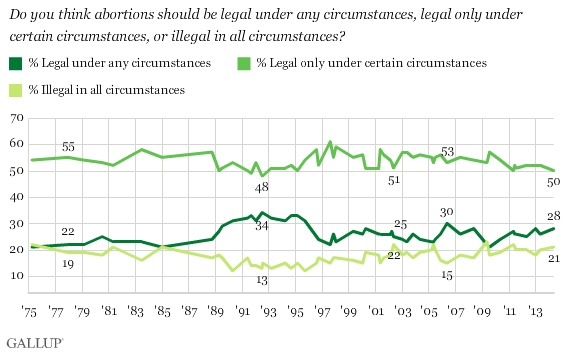
As the 2016 presidential election draws near the candidates will begin to come forward on their political ideas and stances on issues. One of the most controversial issues that they will talk about is abortion. Abortion is a very old medical practice, it appears in one of the oldest known medical texts dating between 2737 BC and 2696 BC (Joffe). Obviously abortion is not the only issue that will be a deciding factor for voters, but it is considered “non-negotiable” by many and can greatly affect who someone will support.
In the landmark case Roe v. Wade, 1971, the Supreme Court ruled that abortion was legal under any circumstance during the first trimester. This ruling was based on the 14th amendment and was recognized in the Griswold v. Connecticut case. The Roe v. Wade case also set rules for limiting abortion in the second and third trimesters based on state interest (Oyez).
Until the late 60’s to early 70’s abortion was not a major political issue because most people just didn’t talk about it. It was a private matter that should be resolved with your family at home. Even though abortion wasn’t a big political issue until relatively recently, birthcontrol, its older brother, has been a major political issue for over 100 years. The birth control issues date back to 1916 with Margaret Sanger’s birth control clinic and her movement to educate women about birth control. However, her distribution of information about contraceptives was banned under the Comstock Laws (NPR). This eventually led to legal battles and the ruling that it was legal for doctors to talk to patients about birth control.
Since Roe v. Wade people have begun to push back against the ruling. There has been a growing movement for “pro-life”, people wanting to put more limits on abortions or even ban them all together. There has also been a push in the other direction, “pro-choice”, people wanting to restrict abortion less and people who want to make sure the government doesn’t limit abortion even more.
I would say that I am pro-choice, this is America, if a women wants an abortion than she should have access to safe and legal options. Just like with drugs, making something illegal doesn’t mean that it goes away. It just means that women who have no where else to go are at risk for going to jail. It also means that women who want abortions will be forced to either go out of the country, or get an illegal abortion which is much more dangerous than a properly performed medical procedure.
Polls about abortion in the US show that since 1975, on average 26.3% of people think that abortion should be legal under any circumstance, on average 53.6% of people think that abortion should be legal under certain circumstances, on average 17.7% of people think that abortion should be illegal under all circumstances, and on average 2.5% of people had no opinion (chart 1+2 and gif 1). They also show that since 1996 the “pro-choice” “pro-life” divide is almost 50/50 (chart 3). Clearly abortion has become a major political issue in the US and there is a lot of data on it. The frequency of the polls has also risen (chart 1 and gif 1). Finally, we see that “the number of restrictions enacted between 2011-2013 was higher than in the entire previous decade” (chart 4)
 |
| Chart 1 Gallup poll |
 |
| Chart 2 Gallup poll |
 |
| Chart 3 Gallup poll |
 |
| Chart 4 Guttmacher.org |
 |
| Gif 1 (data from chart 1) |
Bibliography
“Abortion Surveillance — United States, 2010.” Centers for Disease Control and Prevention. Centers for Disease Control and Prevention, 2013. Web. 14 May 2015. <http://www.cdc.gov/mmwr/preview/mmwrhtml/ss6208a1.htm?s_cid=ss6208a1_w>
“How Birth Control And Abortion Became Politicized.” NPR. NPR, n.d. Web. 14 May 2015. <http://www.npr.org/2011/11/09/142097521/how-birth-control-and-abortion-became-politicized>
Joffe, Carole. “Abortion And Medicine: A Sociopolitical History.” Management of Unintended and Abnormal Pregnancy (2009): 1–9. Web. <http://media.wiley.com/product_data/excerpt/62/14051769/1405176962.pdf>
“ROE v. WADE.” Roe v. Wade. N.p., n.d. Web. 14 May 2015. <http://www.oyez.org/cases/1970-1979/1971/1971_70_18>
“Thirteen Charts That Explain How Roe v. Wade Changed Abortion Rights.” Washington Post. The Washington Post, n.d. Web. 14 May 2015. <http://www.washingtonpost.com/blogs/wonkblog/wp/2014/01/22/thirteen-charts-that-explain-how-roe-v-wade-changed-abortion-rights/>